The next
Shocklab Seminar will be held in person on
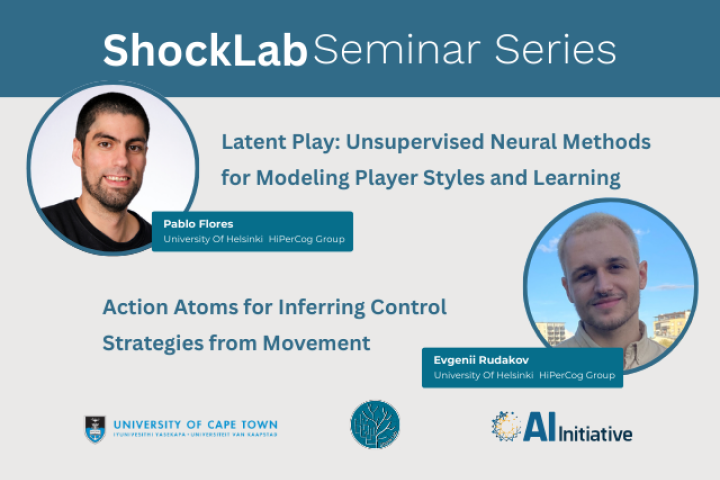
Wednesday, 3 December 2025, from 15:00 - 17:00. We will be hosting two seminars by doctoral candidates
Pablo Flores and Evgenii Rudakov, from the High Performance Cognition Group, University of Helsinki, who will present their current work.
The first talk begins at 15:00, followed by a short break, with the second talk starting at 16:00. Both sessions will take place in Room M209 in the Mathematics Building, at UCT (online component available).
15:00 - 15:45 | Latent Play: Unsupervised Neural Methods for Modeling Player Styles and Learning — Pablo Flores
15:45 | Coffee Break
16:00 - 16:45| Action Atoms for Inferring Control Strategies from Movement — Evgenii Rudakov
16:45 | Discussion/close
Full abstracts and bios for both speakers are provided below.
You are welcome to attend either talk or both — swing by if you can, it’s sure to be an engaging set of talks.
Titles: Latent Play: Unsupervised Neural Methods for Modeling Player Styles and Learning — Pablo Flores
Action Atoms for Inferring Control Strategies from Movement — Evgenii Rudakov
Speakers: Pablo Flores and Evgenii Rudakov (University of Helsinki, HiPerCog Group)
Date: Monday, 8 December 2025
Time: 15:00-17:00 (GMT +2)
Venue: M209, Mathematics Building, University of Cape Town
Abstract:
Latent Play: Unsupervised Neural Methods for Modeling Player Styles and Learning
Understanding how humans play can provide insights in cognition and learning. Video-games offer rich environments where players engage with high levels of intrinsic-motivation. My research focuses on video-game player modelling using data-driven methods to understand how play patterns evolve with expertise or experiences of flow. This work aims to identify interpretable play-patterns from gameplay logs. By employing unsupervised deep neural network techniques, we can embed and reduce the dimensionality and complexity of multi-variate data samples, allowing us to cluster play-sequences by similarity and assign player membership to them. Beyond static classification, we can quantify and visualise how players navigate between patterns over time, and how these latent trajectories relate to learning dynamics. Here I present early results, and ongoing challenges—particularly the interpretability of latent gameplay representations and the validation of clusters as psychologically meaningful “play styles”.
Action Atoms for Inferring Control Strategies from Movement
My research explores how people generate continuous movements in visually guided tasks and which factors shape this behavior. I treat fluid movement as built from small “action atoms” that approximate voluntary motor commands and study how their selection depends on experience, task complexity, and internal state (via physiology and self-reports). Methodologically, I use deep learning, guided by motor control theory, to decompose movement into such atoms. On top of this representation, I train reinforcement-learning agents that predict action atoms from task states while facing human-like limits such as noisy sensing, motor variability, and bounded planning. These constrained agents act as generative models in a Bayesian framework that infers which constraint profiles best explain individual behavior and how these profiles relate to individual characteristics.
Bio:
Pablo, known as Pipa, is a doctoral researcher on the CLIC program. In Chile, he completed a teaching degree and taught high-school technology and physics. He joined the HiPerCog lab in 2023 for his Master’s thesis exploring how researchers navigate AI-generated information. His work spans quantitative and qualitative methods and the interplay of digital technologies and cognition.
Evgenii is a doctoral researcher in the HiPerCog group (since 2023), where he combines machine learning with computational modeling to understand human actions in dynamic environments and how learning shapes them. He holds a bachelor’s in Computer Science and a master’s in Computer Vision and Biometrics, and previously worked in ML R&D. His research uses computational models and physiological signals to study how people adapt control strategies and what behavior reveals about individual characteristics.